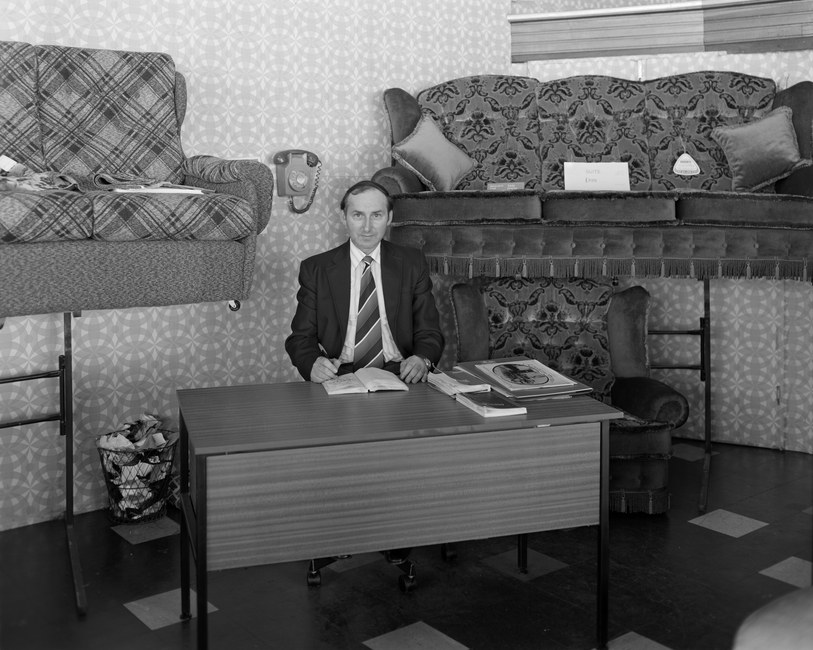
Image: “Sofa Salesman,†1979.
There is a wonderful feature on the photographs of John Myers, which has just published on the New Yorker’s website under the headline ‘The Essence of Britishness, Through the Eyes of an Under-Recognized Portrait Photographer’ by Rebecca Mead.
https://www.newyorker.com/culture/photo-booth/the-essence-of-britishness-through-the-eyes-of-an-under-recognized-portrait-photographer
Myers work was shot throughout the 1970s in the West Midlands, and his pictures have a uniquely British feel to them. The Portraits will be the only complete collection of Myer’s portraiture work ever published, and we are excited to be bringing this master of portrait and setting to a wider audience. The Portraits is limited to 450 copies; each copy of the book will include a 5×4†original silver gelatin print. In addition, copies 1-50 will also contain a 10×8†silver gelatin print. There is a separate portfolio edition of 8 with accompanying presentation box of 12 9.5×12†silver-gelatin prints. Both the 10×8″ print and the set of 9.5×12″ prints are selenium-toned.
John Myers was born in 1944. His photographs were taken between 1972 and 1983 using a 5 x 4 inch Gandolfi plate camera.
RRB Photobooks have just published a book of John’s portraits available here:Â https://www.rrbphotobooks.com/pages/john-myers-the-portraits
23rd April 2018
Binding Hardcover
Size 250 x 285 mm
Extent 176 pages
ISBNÂ 9781999727512
Posted in Uncategorized | Comments Off on John Myers, ‘The Essence of Britishness’
February 13th, 2015 admin
We English by Simon Roberts, “Banal Nationalism†in Landscape? is a journal article by Karine Chambefort-Kay, Université Paris-Est Créteil, from the new issue of Journée d’études, entitled “The American and British Nations in Contemporary Landscape Photography” (December 2014)
Abstract
This paper studies the case of a landscape photography project by British photographer Simon Roberts: We English—the project comprising the book published by Chris Boot in 2009, exhibitions of the large format prints of the photographs, and the artist’s dedicated website with a blog and forum for the public to propose subjects. We address the question of English national identity in Simon Roberts’s photos through the concept of “banal nationalism†coined in 1995 by Michel Billig. The first part draws on Billig’s thesis that the nation is “flagged†in the most banal everyday environment and activities, and discusses whether Simon Roberts’s documentary photographs evidence such subliminal national “flaggingâ€. The second part shows the limits of the concept of “banal nationalism†when studying We English because of the complex, collaborative and reflexive nature of the project. By revealing how personal and intertextual references inform both the photographer’s and the viewer’s perception, the artist documents the dialectical process and negotiations at work in national identification. The third part contends that this dynamic approach of Englishness allows Roberts to propose his own re-imagining of the homeland.
On writing about my working practice for the project, Chambefort-Kay comments:
“A vast framework of references is the backbone of the whole project, and it is made visible through various devices. Simon Roberts opts for transparency on the genealogy of his pictures and on his authorial choices. He questions himself and his audience on the cultural filters and the modes of perception that inform their understanding of landscape. Therefore it is crucial to take into account the whole project, that is, to include both the blog and the pictures in our analysis to appreciate the full scope and impact of We English. Beyond merely documenting the English outdoors, Simon Roberts reveals the different ways in which people connect with the landscape both in nature and in pictures. He offers an insight into the mechanisms through which the national community is constantly re-created in landscape, showing that everything is negotiated individually and collectively.â€
And in conclusion, writes:
“We English offers a renewed vision of England. New forms of cohesion and belonging are evidenced, but they are not exclusively found in urban areas. Simon Roberts does not reject the national frame, but reinvents it, by revealing the interactions and relations involved in national identification. The photographs of We English and the whole project actually display the openness of conviviality, which “makes a nonsense of closed, fixed and reified identity and turns attention toward the always unpredictable mechanisms of identification†(Gilroy, 2005, xvi). The nation is re-imagined through a new, dynamic, open vision of England.â€
You can download a pdf of the full article here.
Chambefort-Kay recently completed a PhD entitled “Ecritures photographiques des identités collectives, Grande-Bretagne, 1990-2010â€, which deals with many British photographers and exhibitions from the period and includes some chapters about We English and The Election Project.
Posted in Uncategorized | Comments Off on Banal Nationalism in Landscape
February 13th, 2015 admin
Perspectives on place: theory and practice in landscape photography (Bloomsbury, 2015)
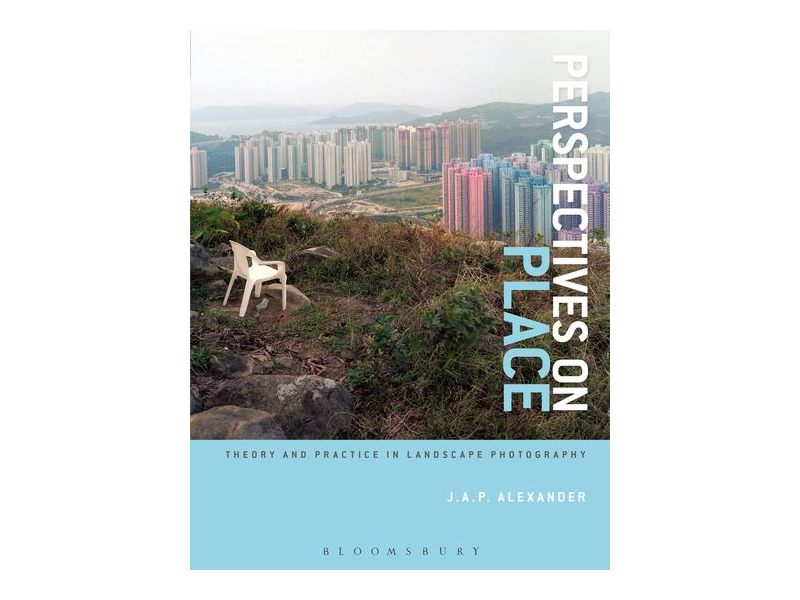
Perspectives on Place by J.A.P Alexander is a new book exploring the history of landscape photography and looks critically at how contemporary photographers continue to find new and innovative ways of engaging with the landscape and their surroundings. It looks at the visual approaches that have been adopted by photographers and artists to facilitate the communication of ideas and themes, as well as more abstract concepts. Practical issues, such as effective composition and managing challenging lighting conditions are also discussed.
Alexander references We English in the chapter Landscape and Power – Inspiring Nationhood. He writes:
“Simon Roberts’s major project We English is a survey of the contemporary English landscape and picks out peculiarities and eccentricities, as well as more commonplace activities of its inhabitants. While the project is likely to be immediately accessible to British audiences, there is a danger this kind of project might leave foreign audiences at loss as to how to interpret the subject matter or even how to confine a nation to conformed stereotypes.
Roberts’s work has been compared to Martin Parr’s Think of England (2001), which isolates English stereotypes more explicitly. Roberts’s photographs are, of course, created and read in a landscape paradigm. The photographer looks specifically at the diversity of English leisure activities in relation to the landscape, ranging from the bizarre – the annual Mad Maldon Mud Race in Essex – to the intimate – Roberts’s photograph of the South Downs in Sussex shows what we assume is a young couple relaxing in a field, a curious echo of the pastoral motif of young villagers courting. As well as the presentation of clichés, such as the couple picnicking barely a few meters away from their car in the Yorkshire Dales, Roberts challenges stereotypes about the English landscape.”
Published: 29-01-2015
Format: Paperback
Edition: 1st
Page Count: 192
ISBN: 9781472533890
Imprint: Fairchild Books
Posted in Uncategorized | Comments Off on Perspectives on Place
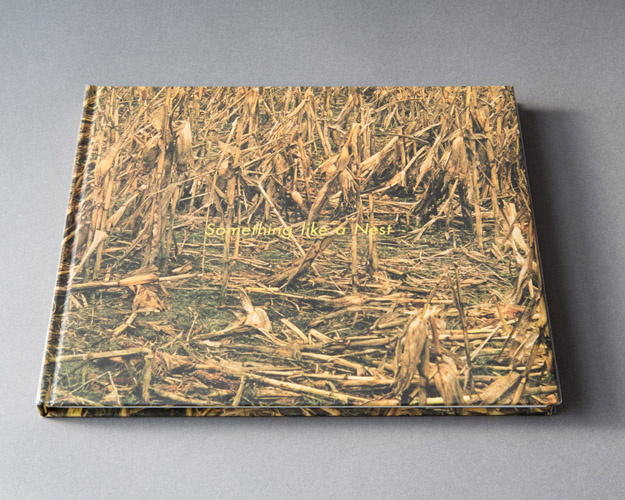
The odd yet unmistakeable character of English country life is revealed in Andy Sewell’s new book, ‘Something like a Nest’.
View the images here.
“Andy Sewell’s photographs are clearly a record of the countryside. But his pictures are about something less obvious: the redundancy of the ideas we have about the pastoral when they come up against modern life. As a knitting together of the artificial and unmade, the English countryside is a perfect expression of our unstable world. Sewell shows us a landscape governed by forces beyond individual or collective control. He doesn’t mind if we are provoked. He’s happy to make us laugh. There isn’t something he needs us to believe. He doesn’t want to shatter our illusions, merely quieten them – to allow us to see the complexity of what’s before us.†Financial Times
Posted in Uncategorized | Comments Off on Recommended: Something like a Nest
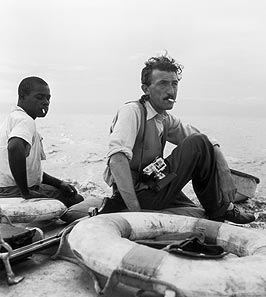
Photo: UGANDA, 1951 — Self-portrait of photographer Thurston Hopkins. 2558757, © Getty Images.
In memory of Thurston Hopkins, the British photographer who died last week at the age of 101, here’s a small tribute by the blog ‘Britain is no country for old men’.
You can also read an obituary in the Guardian here.
Posted in Uncategorized | Comments Off on In memory of Thurston Hopkins
Estuary England is a short film exploring the area around the Queen Elizabeth II Crossing at West Thurrock. It is the first part in a wider PhD study by Simon Robinson exploring the Thames Gateway region and the pull of the contemporary ‘empire of London’ in its surrounding satellite towns.
Estuary England from Simon Robinson on Vimeo.
Robinson is currently working on an AHRC funded practice based PhD, entitled Archipelagos of Interstitial Ground: Investigating edgelands in the UK through photographic practice at the University Of Arts London, working out of the Photography and the Archive Research Centre (PARC).
You can follow his progress via his blog Driving Thru Wasteland here: simonleerobinson.wordpress.com
Posted in Uncategorized | Comments Off on Estuary England
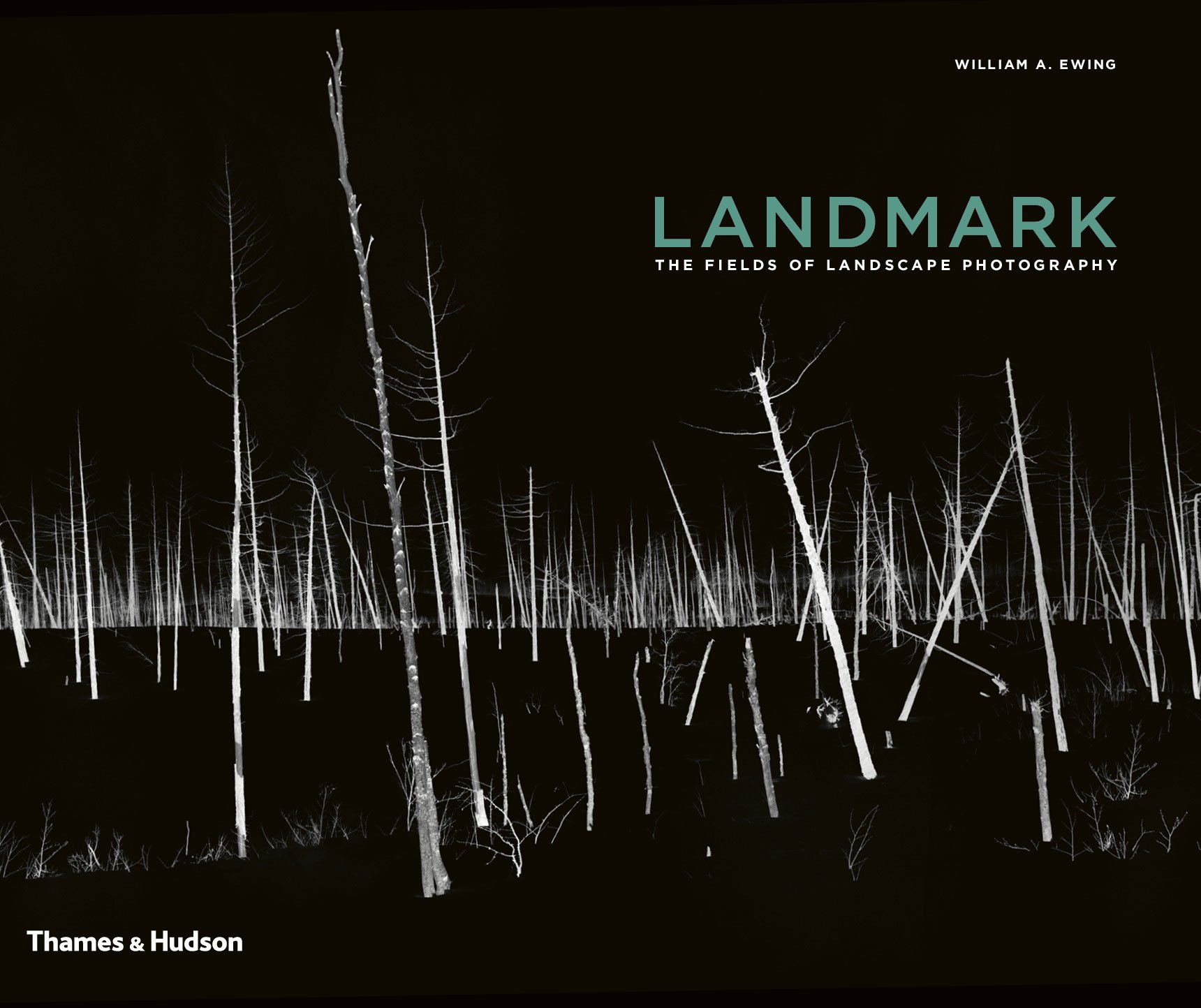
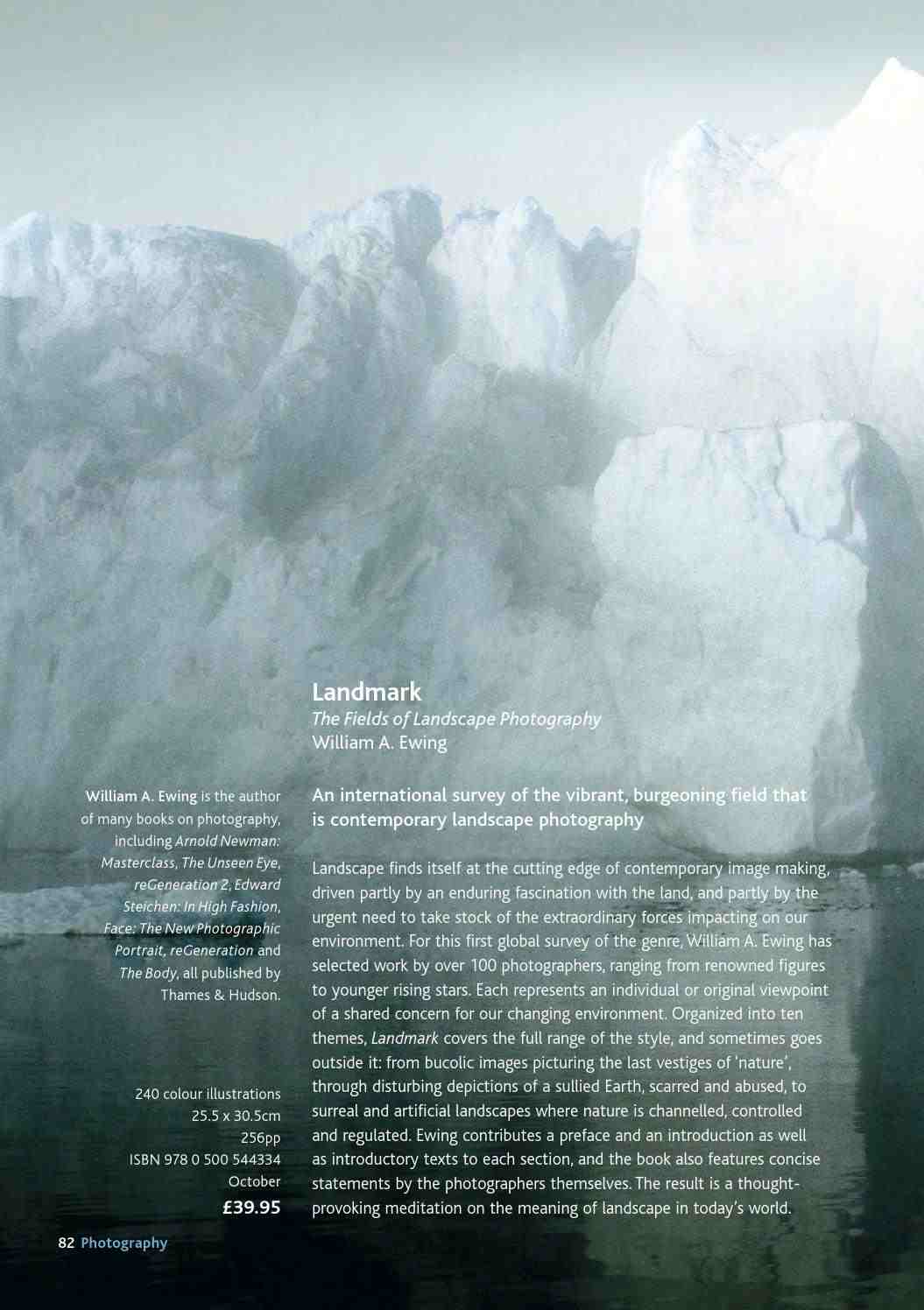
A series of photographs from my We English series are included in this new survey of contemporary landscape photography produced by curator William A. Ewing and published by Thames&Hudson.
ABOUT: Landmark is a defining survey of contemporary landscape photography featuring more than 230 images by over 100 leading photographers of today, all of whom present an individual viewpoint about a shared concern for our changing landscape and environment. The book is organized around ten themes and includes work by such distinguished practitioners as Edward Burtynsky, Stéphane Couturier, Mitch Epstein and Sally Mann. From restful, bucolic images capturing the last vestiges of nature, through shocking depictions of a sullied Earth, scarred and abused, to surreal and artificial landscapes where the natural landscape is a highly controlled one, the book provides a thought-provoking meditation on the meaning of landscape in todays world. The well-known writer and curator William A. Ewing contributes introductory texts to each of the sections, as well as the preface and introduction. Landmark also features statements by the artists themselves.
In reference to We English, Ewing writes:
“As the historian Simon Schama has noted, the pastoral is ‘a product of the orderly mind rather than the playground of the unchained senses.’ Simon Roberts’s images of the English at play illustrate this point beautifully; a people at ease with themselves and surroundings, ‘exploring and examining their own countryside, eulogizing its obvious virtues… making a virtue of its drawbacks, and assuring themselves that no country in the world is quite so pleasant’. In fact, those words were used to describe England as photographed by the thoughtful Edwin Smith almost a century ago. Yet they apply beautifully to Roberts’s world.â€
The book is organized into ten themes—Sublime; Pastoral; Artefacts; Rupture; Playground; Scar; Control; Enigma; Hallucination; and Reverie—Landmark is an intelligent and poetic survey which captures a genre of photography to perfection.
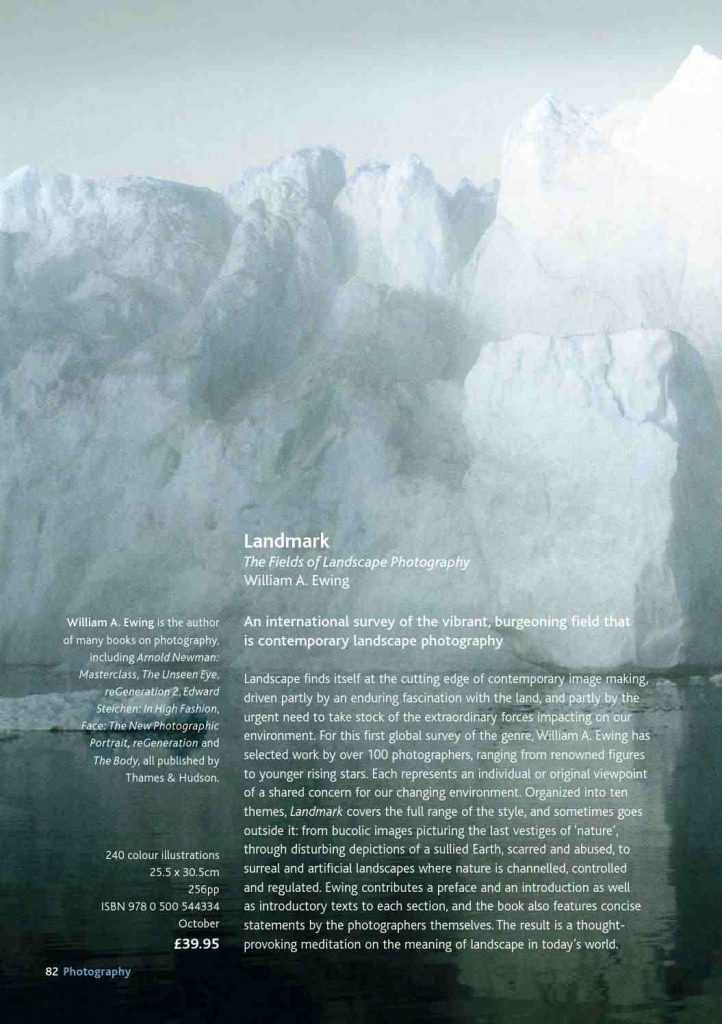
Details
- Format: Hardcover
- Pages: 256
- Artwork: 240 color illustrations
- Size: 12 in x 10 in
- Published: September 16th, 2014
- ISBN-10: 0500544336
- ISBN-13: 9780500544334
Available on Amazon, here.
Posted in Uncategorized | Comments Off on Landmark: The Fields of Landscape Photography
Prints from We English will be included in a survey exhibition at the Multimedia Art Museum in Moscow, which presents work I’ve been making since 2005 after the completion of my Russian series, Motherland.
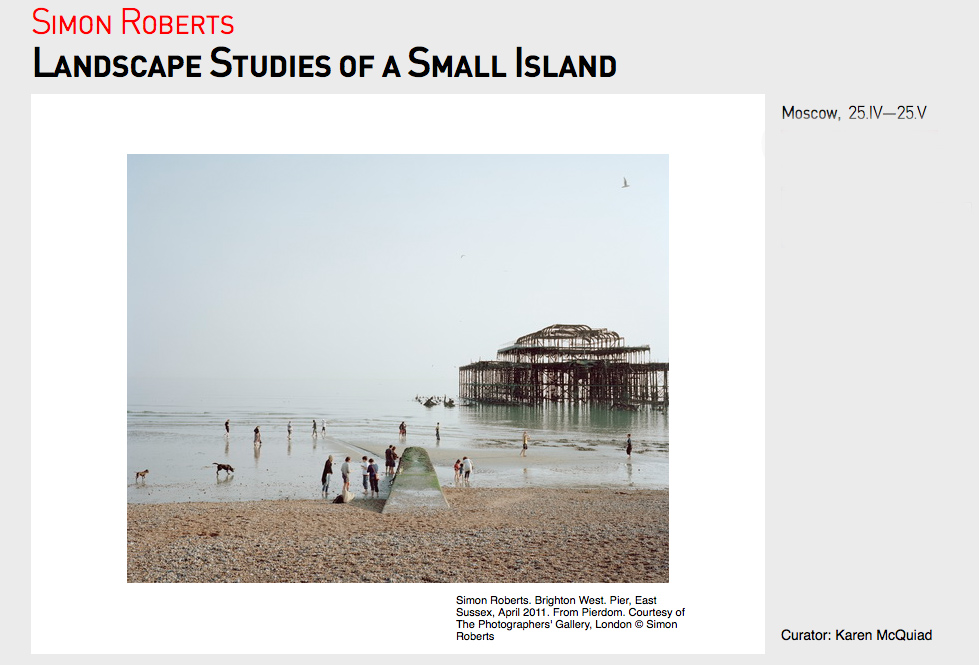
With renewed interest in the relationship of individuals and groups to the landscape, my work has focused on social practices, customs, cultural landmarks, economic and political scenarios that define this ‘small island’ as uniquely British. With echoes of ‘history painting’, the photographs point to contemporary issues specific to Britain, but equally engage with universal ideas of the human relationship to landscape, of identity and belonging.
Landscape Studies of a Small Island is presented as part of the UK Russia Year of Culture in 2014.
The exhibition is curated by Karen McQuaid from The Photographers’ Gallery, London.
More information here: http://www.mamm-mdf.ru/en/exhibitions/landscape-studies-of-a-small-island/
Posted in Uncategorized | Comments Off on Landscape Studies of a Small Island, MAMM
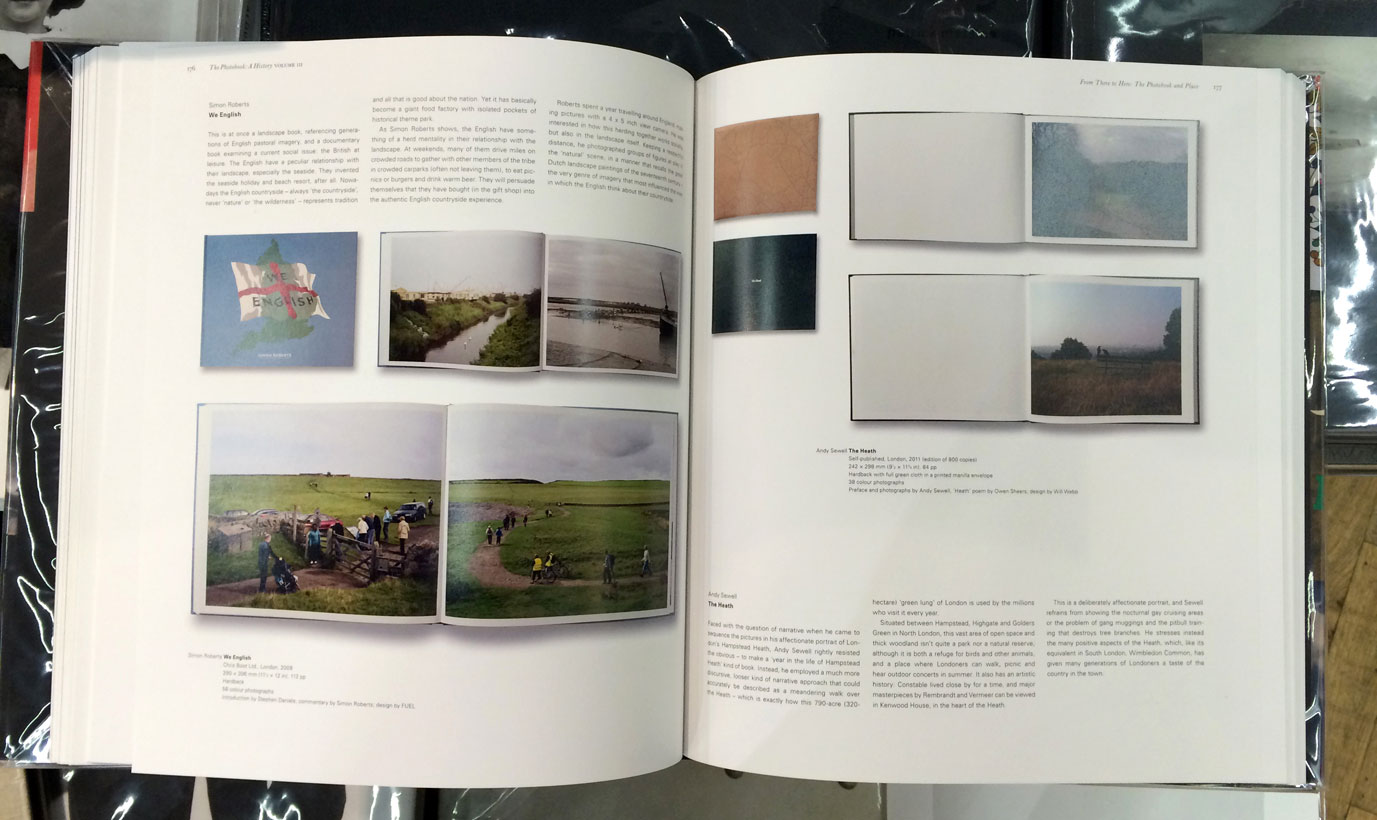
We English is featured in the third and final volume of Phaidon’s Photobook series, described as ‘the most important contribution to the field since modern histories of photography began to appear in the early 20th century’ (photo-eye) and produced by Martin Parr and Gerry Badger.
See more here.
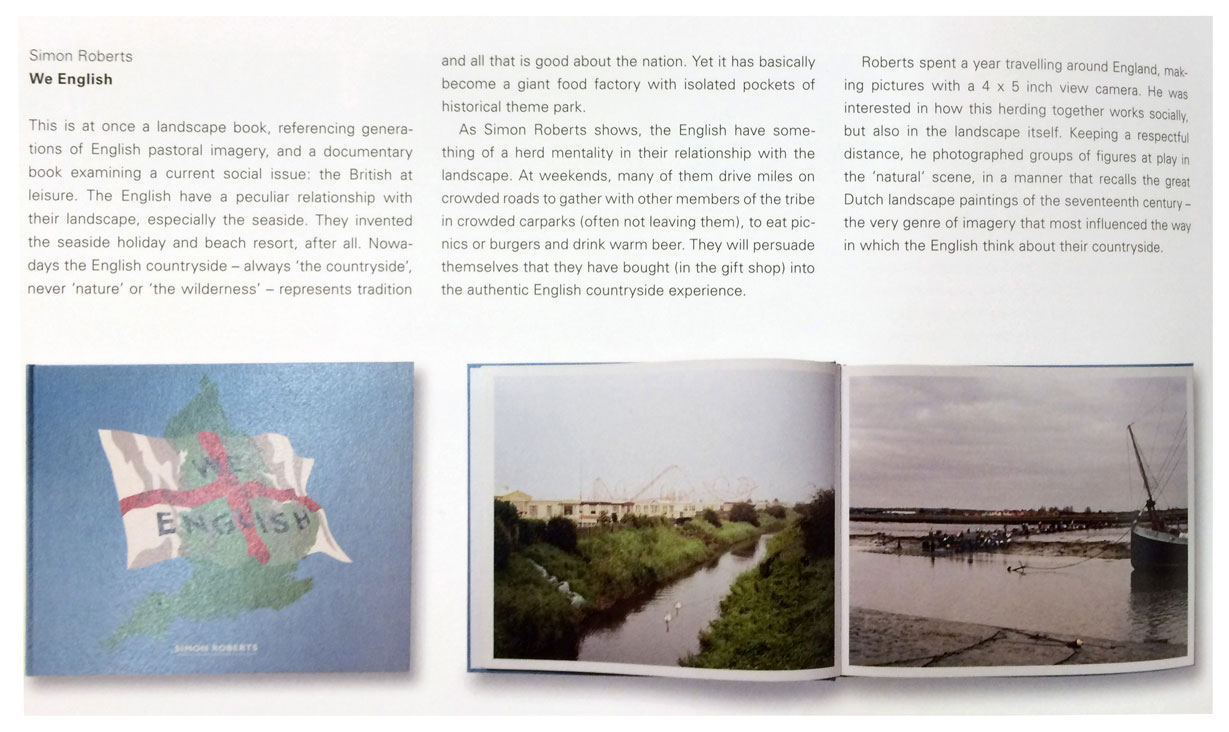
ABOUT THE BOOK
Following the success of volumes I and II of The Photobook: A History, this third volume brings the history of the photobook up to date, with specific exploration of postwar and contemporary examples. It covers key themes including the globalization of photographic culture, the personalization of photobooks, the self-publishing boom and the new ‘layered’ photobook approach.
While the history of photographs is a well-established canon, less critical attention has been directed at the phenomenon of the photobook, which for many photographers is perhaps the most significant vehicle for the display of their work and the communication of their vision to a mass audience. Volume III, co-edited by Martin Parr and Gerry Badger, expands this study and history of the photobook further. It explores the symbiotic relationship between the contemporary propaganda book vs. the protest photobook, sex and youth culture, photographers examining their own environments and the impact of the Internet and social media on the nature of the photobook, among much else.
The book is divided into 9 thematic chapters, each featuring general introductory text providing background information and highlighting the dominant political and artistic influences on the photobook in the period, followed by more detailed discussion of the individual photobooks. The introductory chapter texts are followed by spreads and images from over 200 books, which provide the central means of telling the history of the photobook. Chosen by Parr and Badger, these illustrations show the most artistically and culturally important photobooks in three dimensions, with the cover or jacket and a selection of spreads from the book shown.
Phaidon, 2014
Hardcover
11 3/8 x 9 7/8 inches (290 x 250 mm)
320 pages
900 color illustrations
Posted in Uncategorized | Comments Off on We English, The Photobook – A History V.III
February 17th, 2014 admin
Over the life of the We English blog I’ve attempted to add references to other photographic works which have explored notions of the English landscape and Englishness. You can see several of them on my Photographic Timeline and under Other Studies. Of course this is by no means an exhaustive list, rather an organic one which I rely on others to assist in building. I was therefore delighted to receive an email from a reader of the blog, Peter Hamilton, who was kind enough to suggest several books I’d missed. I’ve published the email below and added web links.
Please do email me with any more suggestions, or post them on the blog below. Thanks!
“I was very glad to see you have discovered Edwin Smith. Smith is important to mention because his books (for instance English Parish Churches, first pub 1952) conform to an earlier, broader and essentially illustrative photographic literature that is also about English landscape and thus Englishness – the modern form of “monographic” or “survey” work on particular places, communities, localities, etc being a far more recent thing, apart from some rare earlier and notable examples (cf. PH Emerson‘s work on East Anglia from the 1880s). Nonetheless, detailed photographic inventories of specific locales certainly existed in the 19th century as the source material for a market in postcards and prints for commercial sale.
As you will know, most of Smith’s work (apart from the didactic but fascinating volumes he wrote and illustrated for Focal Press) was done under commission from publishers to illustrate books on a particular topic, usually with a “known” writer (what the French term a “locomotive littéraire”). During his career there really was hardly any scope (or more properly market) for what we would call a photobook in the sense that it has come to have in recent years, and which is now in many ways a somewhat distorting lens for seeing the history of photography (though of course it does describe one contemporary paradigm for photographic publication).
It could be argued that historically-speaking the majority of the most influential photographic books have probably not been “photobooks” as defined in the Parr et al sense. In terms of launching public interest in photography for instance, the impact of the “Family of Man” book from 1955 was probably immensely greater than that of Frank’s “Americans“, which itself was far outdistanced even within the smaller circles of enthusiast photographers by HC-B’s “Decisive Moment/Images à la sauvette” of 1951. There are generational aspects to this question, of course.
So I think you could add several of the Smith books to the list – such as Parish Churches, England (with G. Grigson), English Cottages and Farmhouses, etc. There is a good bibliography in Elwall (here is link to Elwall’s article on Culture 24 ‘Edwin Smith: from English parish to Pompeii‘)
But my main point was to offer a couple of other practical suggestions/corrections on the Photographic Timeline re Ravilious and others.
Firstly, on James Ravilious.
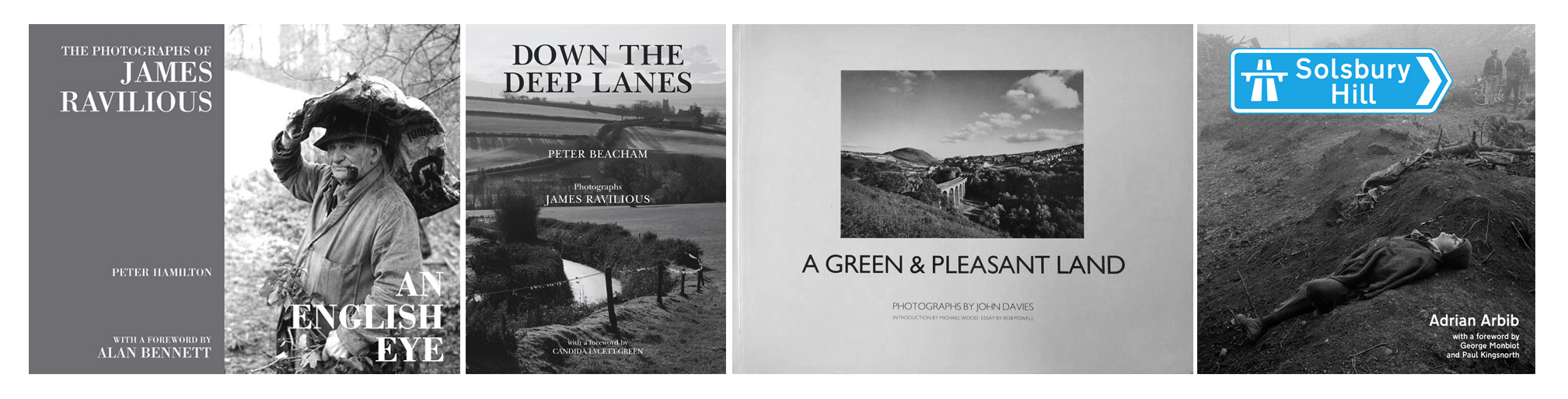
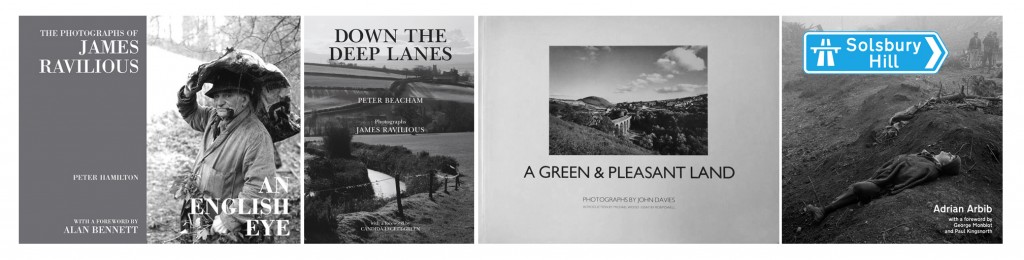
His first book which I think should figure on your list was (1980) The Heart of the Country, with Robin Ravilious, London, Scolar Press. This displayed the first fruits of his work for Beaford Trust on North Devon land and people from c.1972.
In 2005 he published A Corner of England: North Devon Landscapes and People, Tiverton, Devon Books and Lutterworth Press. This also contains examples of his colour work, though the book was very poorly printed.
Can I also suggest you refer to An English Eye in its first edition (1998, Devon Books, Tiverton but printed quite well by Jackson Wilson in Leeds). The 2007 volume published by The Bardwell Press and printed by EBS in Verona is the 2nd edition, better printed though hardly changed except for the bibliography and couple of minor corrections.
In 2000 Down the Deep Lanes was published, with a text by Peter Beacham. This was a thematic book about characteristic aspects of the South-West’s landscape, vernacular architecture and rural communities using some photographs from the Beaford project, but mainly others specially made for it in Devon and Cornwall up to 1999, the year of Ravilious’s death. It was re-published in 2008 in a slightly revised second edition, again by The Bardwell Press.
Other work on England I think you might note:
John Berger and Jean Mohr (1967) A fortunate man: The story of a country doctor (1969, Penguin)
Chris Chapman (2000) Wild Goose and Riddon, Tiverton; Halsgrove.
Chris Chapman and James Crowden (2005) Silence at Ramscliffe, Oxford The Bardwell Press.
Patrick Sutherland and Adam Nicolson (1987) Wetland: Life in the Somerset Levels, London, Michael Joseph.
Adrian Arbib (2009) Solsbury Hill; Chronicle of a Road Protest, Oxford, The Bardwell Press.
Ian Beesley‘s work is interesting but is not easily accessible in book form for some reason.
John Davies (1987) Green and Pleasant Land, Manchester, Cornerhouse, was very influential, I believe.”
Peter Hamilton, 14 January 2014
Posted in Uncategorized | Comments Off on Extending the photographic timeline